Inquisition
The Moon and the SunThe Inquisition appears as an institution empowered to identify and suppress demonic influence, but its claims to religious authority are tested by the sea people’s intelligence and by the possibility that the Church has misclassified them. Its record of torture and execution makes that dispute material: whether the sea people are treated as demons, beasts, or human beings determines what may be done to them.
Institutional role and authority
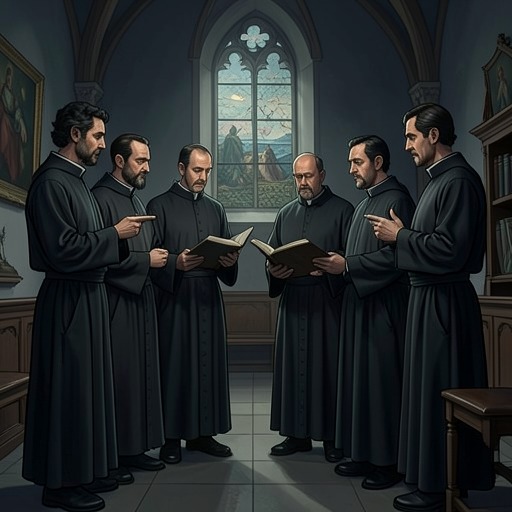
The Inquisition enters the debate through Pope Innocent’s account of the Church’s earlier confrontations with supposed demonic possession. When Count Lucien de Barenton, Count de Chrétien argues that the Church may once have mistaken beasts for demons, Pope Innocent rejects the suggestion of error. He maintains that the Inquisition drove out satanic influence. The institution is thus presented not merely as a tribunal but as the means by which the Church claims to have detected and expelled a spiritual threat.
That claim gives the Inquisition weight in arguments about the sea woman before anyone establishes what she is. The dispute concerns more than a name: if she is judged a demonic being, the Church’s precedent appears to authorize coercive intervention; if she is an intelligent person, that precedent may instead expose a failure of judgment. The novel does not supply a detailed account of the Inquisition’s organization or procedures. Its authority is conveyed through the Pope’s defense of its past action and through the consequences characters anticipate when its agents might take custody of a captive.
Classification and contested proof
The sea woman’s status is disputed in public and consequential terms. Marie-Josèphe de la Croix argues that the being in the fountain speaks, understands, and is human. Louis XIV challenges her by asking what makes the sea woman anything other than a monster, while Yves de la Croix dismisses her intelligence. These competing judgments show how easily observed capacities can be discounted when the subject has already been assigned a category that denies her personhood.
Count Lucien de Barenton, Count de Chrétien presses the debate toward evidence. He argues that a creature’s status has changed before and could change again, and that the question to establish is whether it speaks a human language. He invokes the demands of scientific proof and asks Louis XIV to let Marie-Josèphe demonstrate her case. This appeal directly contests the presumption that inherited religious classifications settle the matter in advance.
Pope Innocent sets a different test. He asks whether Marie-Josèphe has discussed souls and Christian faith with the sea woman or converted her, and challenges her to explain why she believes the Church is wrong. The exchange reveals a clash over what counts as proof: the Pope invokes religious knowledge and conversion, while Lucien calls for demonstrable evidence about language and understanding. In this setting, the sea woman’s ability to communicate is not a curiosity detached from policy. It bears on whether she can be treated as a speaking subject or subjected to a religious category that strips her of that standing.
Violence and the record of persecution
The consequences of religious classification are made visible in Marie-Josèphe’s sketch. It depicts an Inquisitor breaking a sea person on the rack, with a human being burning at the stake in the background. The image places the persecution of the sea people alongside human execution, connecting the institution’s treatment of those called demonic with familiar forms of religious violence. It is a visual record within the narrative, not an abstract accusation: the rack and the stake give physical form to the testimony that the captives were taken to mainland cities, imprisoned, tortured, and killed slowly.
That history shapes Lucien’s response to the possibility of Church custody. At the royal presentation, he hopes that the Pope’s inquisitors will not be set upon the sea woman. He considers imprisonment by the Church a postponement of death, even when it might be more merciful than being butchered and cooked by M. Boursin. The prospect of reprieve remains possible, but remote. His reasoning does not treat religious confinement as protection in any secure sense; it measures one threatened fate against another, with the captive’s continued life dependent on the decisions of powerful men.
The Inquisition as a continuing threat
The institution’s past is also used against people beyond the sea community. When Pope Innocent turns on Lucien during the argument, he suggests that the Grand Inquisitor may have been right and associates Lucien and the sea people with demonic parentage. The accusation collapses disagreement about evidence into a suspicion of spiritual corruption. It also shows how the Inquisition’s authority can linger in a debate even when no inquisitor is physically present: its prior judgments become a weapon in the Pope’s attempt to discredit those who question the Church.
The novel therefore presents the Inquisition through a tension between asserted spiritual protection and the violence carried out in its name. Pope Innocent describes its past as the expulsion of satanic influence; Marie-Josèphe’s sketch and Lucien’s fears disclose the human cost of that account. The sea woman’s contested status makes the tension immediate, because a change in classification could alter whether she is heard, converted, confined, or killed. The evidence leaves the institution’s procedures largely undescribed, but makes its stakes unmistakable: authority over the meaning of a being can become authority over that being’s body and survival.